.avif)



- ERC-7208 decouples storage (Data Objects) from business logic (Data Managers), so multiple interfaces can operate on the same underlying data at the same time.
- We introduce an explicit data layer designed for long-lived systems where rules, standards, and schemas evolve without breaking the asset.
- If you only need a straightforward token or simple upgradeability, stick to simpler patterns. If you need true data independence over time, ERC-7208 is the pattern.
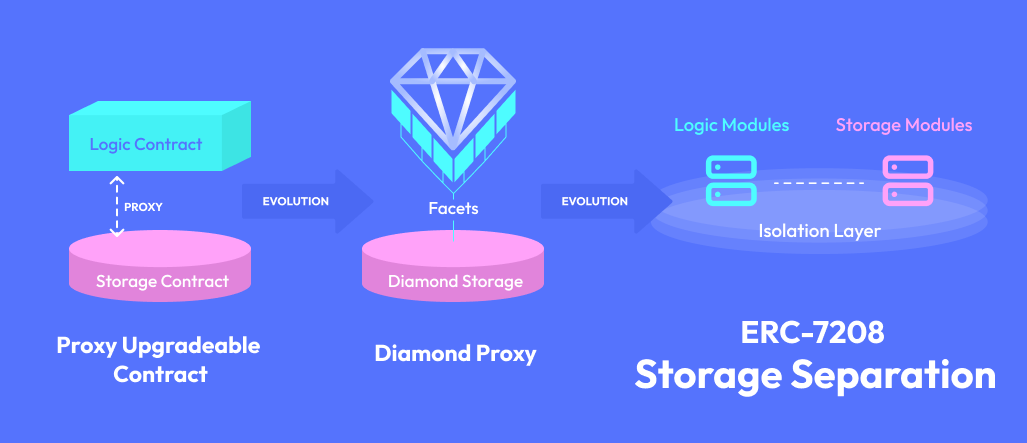
An architectural design pattern is a reusable blueprint for organizing code, enabling different parts of a system to change independently without breaking functionality for the whole. Smart contract architecture has evolved through several design patterns, each solving specific problems while introducing new tradeoffs.
You must have heard that “the blockchain is immutable”, which usually means that vanilla contracts are immutable and “code is king”. Upgradeable proxies kind of solved this by separating state from logic, but storage corruption remains a risk when implementations use slots differently (in other words, a developer can always screw up the smart contract data when trying to upgrade a functionality). The Diamond Proxy (ERC-2535) solved the 24KB bytecode limit by distributing logic across multiple facets, but namespace pollution and storage collisions between facets create coordination overhead. Still, today, both the Upgradeable Proxy and Diamond patterns are extensively used. Few developers in their right mind would consider deploying a non-upgradeable contract unless the specific business requirement demands an unchangeable, "set in stone" statement of immutability. Since their introduction, Diamond Proxies (ERC-2535) have seen a notable increase in adoption as on-chain codebases continue to grow in complexity. Both patterns focus on the same question: how do I upgrade my code while preserving state?
This evolution mirrors the history of traditional software engineering: just as assembly language engineering gave way to high-level programming languages, and new tools were developed to simplify the developer experience in managing ever-growing complexity, smart contract architecture is continuously developing new patterns (like ERC-7208) to handle unprecedented demands for modularity, interoperability, and data independence.
ERC-7208 asks a different question: how do I make my data independent of code so multiple contracts can use it simultaneously?
This shift in perspective is fundamental. Previous patterns treat storage as something logic operates on. ERC-7208 treats storage as an independent layer that multiple logic implementations can access concurrently.
Data Independence as Architecture
ERC-7208 organizes smart contracts into four components, each with a single responsibility.
Data Objects store data and implement primitive operations on that data. A Data Object representing token balances knows how to mint (increase a user's balance), burn (decrease it), and transfer (decrease one balance while increasing another by the same amount). What it does not know or care about is who can execute these operations or under what conditions. Access control and business rules live elsewhere.
Data Managers implement business logic. They define how users interact with data: transfer functions, compliance checks, minting rules, and distribution calculations. A Data Manager presents a familiar interface to the outside world (ERC-20, ERC-721, or any custom interface) while reading from and writing to Data Objects behind the scenes. Data Managers give meaning to the data through the implementation of business rules.
Data Points act as pointers. A Data Point is not a smart contract itself, but a bytes32 identifier that references a specific piece of data within a Data Object. Data Points are managed by a Data Point Registry so that multiple Data Managers can reference the same Data Point, which means multiple contracts can operate on the same underlying data. The Data Point provides a stable address for data regardless of which logic accesses it.
Data Index manages write access. Before a Data Manager can modify data in a Data Object, the Data Index verifies that the Data Manager has permission for that specific Data Point. This gating mechanism ensures that only authorized logic can change stored values.
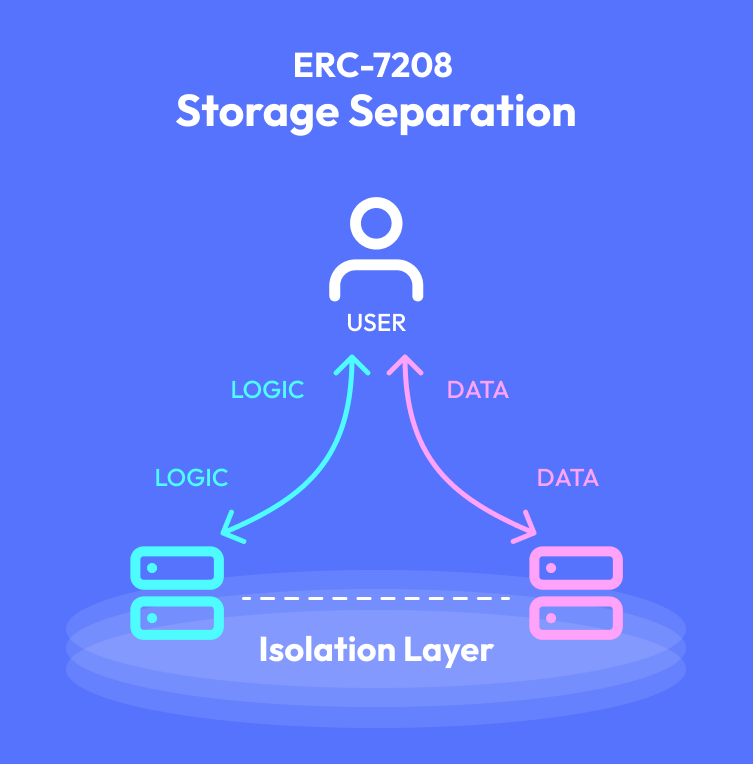
The flow works like this: A user calls a Data Manager. The Data Manager implements the necessary logic (ERC-20/721/1155/3643 token standard interface, compliance checks, balance verification, and fee calculation). When the Data Manager needs to write/store data, it goes through the Data Index. The Data Index checks permissions. If authorized, the operation executes on the Data Object. The data persists, independent of the business logic. The Data Manager returns results to the user. Of course, data can also be read/queried straight from the Data Object, which simplifies read-only operations.
What you trade for data independence
ERC-7208 introduces a deliberate layer of indirection between interfaces and state. Instead of treating storage as a side-effect of a specific implementation, it makes data a stable layer that multiple implementations can access concurrently. In practice, write operations follow a clear path: a Data Manager applies business rules, then routes state changes through the Data Index, which verifies the Data Manager is authorized for the targeted Data Point before the Data Object is updated. That extra hop is not an accident: it’s the mechanism that keeps data consistent while logic evolves around it.
This shift changes what you optimize for. If your primary objective is to achieve the shortest possible execution path for a single interface, any single classic token standard (e.g., ERC-20/721/1155/3643/1400) or any classic proxy pattern (e.g., Upgradeable or Diamond) approaches will feel more direct. ERC-7208 optimizes for long-lived systems where the same underlying asset must be exposed through different standards (or different versions of the same standard), across jurisdictions, products, and rule sets, without duplicating state, without wrapper synchronization, and without tying the identity of the asset to one “current” implementation.
When you build using the Nexera Standard, you are also composing a system rather than deploying a monolith: Data Points are allocated and referenced, Data Managers are attached as interfaces, and write authority is explicitly granted and scoped. This structure demands more discipline at setup time, but it makes responsibilities clearer, reduces hidden coupling, and turns “multi-standard exposure” into a native capability.
When Data Independence Matters
The pattern earns its complexity in specific scenarios.
Multi-standard exposure: when a single asset must present as ERC-20 to DeFi, ERC-3643 to compliance systems, and custom interfaces to reporting tools simultaneously. One Data Object, multiple Data Managers, no synchronization bugs. The Nexera Standard enables a single asset to be expressed as multiple different interfaces concurrently.
Complex evolving logic: when business rules span hundreds of components and regulations shift across jurisdictions. Diamond proxies share storage across facets, risking namespace collisions. ERC-7208 isolates the storage entirely, leaving the logic of the Data Managers as a set of independent components that can evolve through versions, jurisdictions, and functional requirements. The storage layer itself is also versatile. If you need to evolve a struct definition in a Data Object, ERC-7208 abstracts storage at the lowest level, enabling the migration through Horizontal Mobility or “Data Portability”. For instance, you can switch Data Index implementations during the lifetime of your application while keeping the same Data Points and Data Objects, effectively migrating your access control layer without touching the underlying data.
Forward compatibility under genuine uncertainty: when you cannot predict whether your token will need to represent something entirely different in two years. Most projects underestimate their uncertainty.
If you need a plain token, deploy a plain token. If you need upgradeability without interface changes, use UUPS with multisig. ERC-7208 is for when simpler patterns cannot deliver what you need, when you know for a fact that things are changing, and you don’t know where code will land.
Where the Pattern Extends
The Nexera Standard applies wherever data must outlive the logic operating on it: on-chain AI model registries with evolving licensing logic, supply chain tracking with attestations from incompatible systems, CBDCs requiring policy evolution independent of balances, omnichain stablecoins with unified cross-chain identity, and large omnipresent protocols spawning different architectures that rely on consistent, uniform data access.
Production deployments in RWA tokenization, cross-chain coordination, and AI agent economies have validated that the pattern works. The question is whether your requirements demand what only data independence provides.